
Will solar panels actually save you money, or are they a financial mirage? The answer lies in a precise calculation of solar savings and ROI, a process that moves beyond guesswork to reveal the true value of your investment. Getting this number right means looking at your current energy bills, future utility rates, equipment costs, and available incentives. This guide provides the framework and formulas you need to make a data-driven decision.
The Core Components of Your Solar Financial Analysis
An accurate solar financial analysis starts with gathering specific data about your home and local market. You cannot estimate your return without knowing your starting point. This involves more than just the price of the panels; it requires a holistic view of your energy profile and the economic environment.
First, examine at least twelve months of your electricity bills. This shows your annual kilowatt-hour (kWh) consumption and reveals seasonal usage patterns. Your future solar system must be sized to meet this historical demand. Next, research current retail electricity rates in your area. Most utility companies increase these rates by 3% to 5% annually. A proper energy savings calculation must account for this inflation.
Finally, obtain a detailed quote for your proposed solar panel system. This should include the total cost before incentives, the system’s size in kilowatts (kW), and the estimated annual energy production. With these three data points, your consumption, your utility’s rates, and your system’s cost and output, you can begin the real math. For a deeper look at available financial help, review our guide on current solar incentives and rebates.
Understanding System Cost and Production
The upfront solar panel cost analysis is critical. In 2026, the average cost for a residential system ranges from $18,000 to $35,000 before incentives, depending on size, equipment quality, and installation complexity. This price typically includes panels, inverters, mounting hardware, labor, permits, and interconnection fees. Your installer’s quote should also provide an estimated first-year production in kWh, based on your roof’s orientation, tilt, and local sunlight hours. For instance, a south-facing roof in Phoenix will produce significantly more energy annually than the same system on an east-west roof in Seattle, directly impacting your savings potential.
The Solar ROI Formula: A Step-by-Step Breakdown
The solar ROI formula measures your return on investment as a percentage. It compares the net financial benefit of the system over its lifetime to its net cost. Here is the fundamental equation you can use.
Solar ROI Formula: (Total Lifetime Savings – Total Net System Cost) / Total Net System Cost x 100 = ROI %
To apply this formula, you need to define its two main variables: Total Net System Cost and Total Lifetime Savings.
1. Calculate Total Net System Cost: Start with the gross price from your installer. Subtract the federal Investment Tax Credit (ITC) and any applicable state or local rebates. Then, if financing, factor in the total interest paid over the loan term. The result is your true, out-of-pocket net cost.
2. Calculate Total Lifetime Savings: This is more complex. Estimate your annual electricity bill savings by multiplying your system’s annual production (kWh) by your current utility rate. Then, increase that saved amount each year to account for rising electricity rates (3-5% annually). Sum these projected annual savings over 25 years, which is the standard performance warranty period for most panels.
Plug these two final numbers into the formula. An ROI above 10% is generally considered a strong investment, often surpassing stock market averages. Many homeowners also use a dedicated photovoltaic savings calculator to automate these projections.
Determining Your Solar Payback Period
While ROI gives you a long-term percentage return, the solar payback period tells you how quickly the system pays for itself. This is the point where your cumulative savings equal your net system cost. Homeowners often find this metric more tangible.
To find your solar system payback timeline, divide your Net System Cost by your Estimated First-Year Savings. For example, a $20,000 net system that saves $1,800 in its first year would have a simple payback period of about 11.1 years. This simple calculation assumes utility rates and system output stay constant, which they do not.
A more accurate method accounts for annual utility inflation. Because your electricity bill savings increase each year, the payback period is often shorter than the simple math suggests. The table below illustrates how inflation impacts the payback timeline for a sample system.
| Year | Annual Savings (3% Rate Inflation) | Cumulative Savings |
|---|---|---|
| 1 | $1,800 | $1,800 |
| 5 | $2,031 | $9,955 |
| 10 | $2,355 | $23,310 |
| 12 | $2,500 | $29,850 |
In this model, the $20,000 system reaches payback between years 10 and 11, not year 11.1. Most quality systems have a payback period between 6 and 12 years, followed by over a decade of virtually free electricity. According to data from the Lawrence Berkeley National Laboratory, median payback periods have decreased by nearly 30% over the past decade due to falling equipment costs.

Key Factors That Directly Impact Your Solar Investment Return
Several variables can significantly alter your calculations. Ignoring them can lead to an overly optimistic or pessimistic view of your solar investment return.
- Financing Method: Paying cash yields the highest ROI because you avoid loan interest. Loans make solar accessible but reduce net savings. Leases or Power Purchase Agreements (PPAs) offer low upfront cost but typically provide a lower long-term financial benefit.
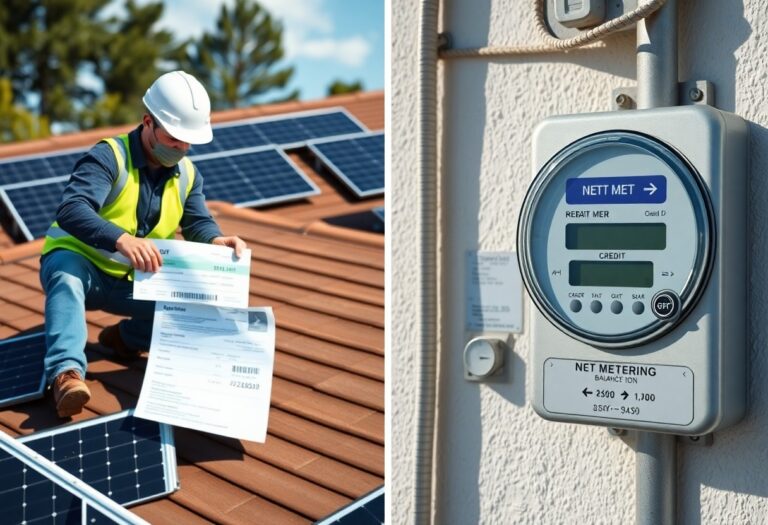
- Net Metering Policy: This is crucial. Net metering allows you to send excess solar power to the grid in exchange for credits on your bill. Favorable net metering rates effectively make the grid your free battery. Unfavorable policies drastically reduce the value of each kWh you export. For example, California’s shift to NEM 3.0 in 2023 reduced export credit values by about 75% for new customers, fundamentally changing the economics of new installations.
- System Degradation: Solar panels slowly lose output over time, typically around 0.5% per year. A high-quality panel will still produce 88-92% of its original output after 25 years. Your production estimates should account for this.
- Added Home Value: Multiple studies confirm solar panels increase property value. The National Renewable Energy Laboratory states that home value increases by $20 for every $1 reduction in annual utility bills. This equity gain is part of your total financial return, even if you sell before the payback period ends.
Advanced Considerations: Storage, Maintenance, and Realistic Expectations
The basic calculation focuses on simple solar energy payback. However, many homeowners consider adding battery storage or wonder about long-term upkeep. These factors change the equation.
Adding a battery increases your upfront cost by $10,000 to $20,000. Its financial justification often depends on having poor net metering rates or frequent power outages. The battery provides backup power and can allow you to use more of your own solar energy, but it extends your payback period. You can evaluate this trade-off in our analysis of battery storage systems.
Maintenance costs are generally low. You should budget for occasional inverter replacement (every 10-15 years) and panel cleaning. Monitoring system performance is essential to ensure you hit your projected savings. Understanding post-installation expectations helps you protect your investment. A 2025 survey by the Solar Energy Industries Association found that 94% of solar owners reported annual maintenance costs under $200.

Putting It All Together: From Calculation to Action
Calculating solar savings and ROI is not a single math problem but a dynamic financial projection. Use the following action plan to arrive at your own confident number.
- Gather Data: Collect 12 months of utility bills. Get 2-3 detailed quotes from certified installers.
- Run Baseline Numbers: Use the solar ROI formula and payback period calculation with your quote data. Assume a 4% annual utility inflation rate.
- Model Scenarios: Adjust for different financing options. Check your local net metering rules with your utility company.
- Seek Expert Verification: A reputable installer should provide a detailed proposal with these calculations. Use your own math to verify their claims.
The final step is to weigh the financial return against your personal goals for energy independence, environmental impact, and resilience. A strong solar investment return makes the decision clear, but even a moderate ROI can be worthwhile when combined with these other values. For many, the security of predictable energy costs and reduced grid dependence provides significant non-financial value.
Frequently asked questions
What is a good ROI for solar panels?
A good solar investment return typically exceeds 10%. Many systems achieve returns between 10% and 20%, which is competitive with other long-term investments. The exact figure depends on your local electricity costs, sunshine, system price, and available incentives.
How long does it take for solar panels to pay for themselves?
The solar payback period averages 8 to 12 years for most homeowners. This timeline can be shorter in areas with high electricity rates and strong sunlight, or longer if financing costs are high or local incentives are limited.
Do solar panels increase home value?
Yes, solar panels generally increase property value. Appraisers often use a valuation method that accounts for the projected energy savings, with studies showing an average increase of 4% to 5% of the home’s total value.
How accurate are online solar savings calculators?
Online photovoltaic savings calculators provide a useful initial estimate but can be inaccurate. They rely on generalizations about your roof and local electricity rates. For a precise figure, you need a detailed site assessment and quote from a local installer.
What happens to my solar savings if I move?
Your savings are transferred to the new homeowner, and the increased property value is realized in your sale price. Ensure your solar system is fully owned (not leased) and that your real estate agent understands how to market the home’s reduced operating costs.