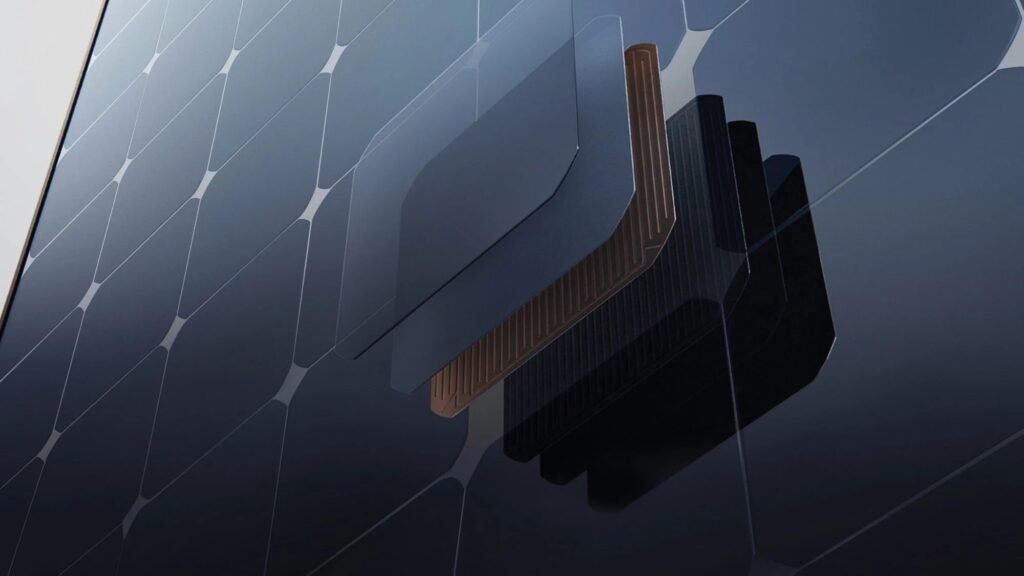
Maxeon Solar — the company formerly known as SunPower’s manufacturing arm — built its reputation on one idea: put the electrical contacts on the back of the cell instead of the front, so nothing blocks incoming sunlight. Seven generations later, the Maxeon 7 is the clearest expression of that idea yet, and it remains the panel to beat for homeowners who want the highest possible output from the smallest possible roof footprint.
Efficiency and Power Output
The Maxeon 7 is rated at approximately 24.1% efficiency in its production residential format — the highest verified efficiency among widely available residential panels in 2026. That number comes from Maxeon’s IBC (Interdigitated Back Contact) cell architecture, which eliminates the front-side metal grid lines that reduce light absorption on conventional panels. Individual panels are typically available in the 430–445W range depending on configuration.
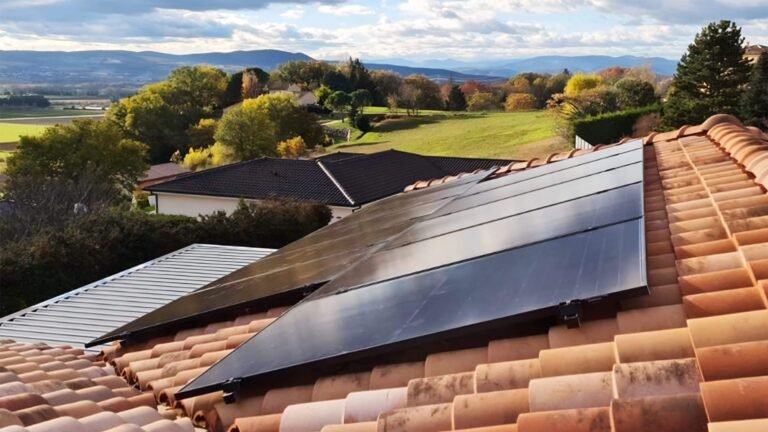
To put that efficiency gain in concrete terms: a system built with Maxeon 7 panels can generate the same output as a system using standard 21% efficiency panels while using roughly 12–15% less roof area. For homeowners with a small or oddly-shaped roof, that difference can be the deciding factor between fitting a system that meets their full energy needs and settling for one that doesn’t.
Temperature Performance
Back-contact cells also tend to run cooler than conventional designs, and Maxeon 7 carries a competitive temperature coefficient in the range of -0.27% to -0.29% per °C. That means for every degree above the standard 25°C test condition, the panel loses roughly a quarter to a third of a percent of its rated output. It’s not quite as strong as the best HJT panels from REC or Panasonic (closer to -0.24% to -0.26%/°C), but it’s still solidly ahead of most mainstream TOPCon panels, which typically sit in the -0.30% to -0.35%/°C range. In hot climates, this translates to meaningfully better real-world summer output than most non-premium alternatives.
Degradation Rate and Long-Term Output
Maxeon backs the 7 with a degradation guarantee that keeps guaranteed output in the 92–95% range at year 25 — well above the industry-standard 84–88% many TOPCon panels guarantee at the same milestone. Annual degradation is typically under 0.4%, and Maxeon’s IBC design has a long field track record supporting those numbers, since the underlying back-contact technology has been in commercial deployment for well over a decade.
Warranty Coverage
This is where Maxeon 7 separates itself most clearly from the rest of the market: it comes with a 40-year product and performance warranty, nearly double the 25-year term that’s standard across almost every other brand on the market, including REC, Qcells, Canadian Solar, and Panasonic. For a homeowner planning to stay in their home long-term, that warranty horizon alone can justify the premium price — it’s a direct signal of how confident the manufacturer is in the panel’s long-term durability.
One caveat: Maxeon’s warranty, like most manufacturer warranties, covers the panel itself rather than labor costs for removal and reinstallation if a claim is ever needed. Ask your installer directly whether they offer any supplemental labor coverage.
Price
Maxeon 7 sits firmly in the premium tier, typically running $0.90–$1.50 per watt for the panel alone — noticeably higher than budget TOPCon options from Jinko or Trina ($0.55–$0.75/W) and mid-tier panels from Qcells or Canadian Solar ($0.70–$1.00/W). A single 440W panel typically costs somewhere around $200–$250 before installation. Fully installed system pricing will depend heavily on your installer, but expect to pay toward the higher end of the $2.50–$3.50 per watt national range when specifying Maxeon panels.
Who Should Buy the Maxeon 7
Best for:
- Homeowners with limited or oddly-shaped roof space who need to maximize output per square foot
- Anyone who wants the longest warranty horizon available in residential solar
- Long-term homeowners who value decades of production certainty over minimizing upfront cost
- Hot-climate installs where a strong temperature coefficient meaningfully improves annual output
Maybe skip it if:
- You have plenty of unshaded roof space and don’t need maximum wattage per panel
- Budget is the primary constraint — a mid-tier TOPCon panel will get you most of the energy production at a meaningfully lower price
- Your installer doesn’t have established Maxeon supply or service relationships in your area
Bottom Line
The Maxeon 7 remains the benchmark premium residential solar panel in 2026. Its combination of class-leading efficiency, strong heat tolerance, and an unmatched 40-year warranty makes it the safest long-term bet for homeowners who can afford the premium — particularly those working with a constrained roof. If you want to see how it stacks up against the panel currently challenging it for the efficiency crown, read our full Aiko Solar review, where ABC back-contact technology is pushing efficiency even further, in some configurations to as high as 25%.
Panel specifications reflect manufacturer datasheets and third-party testing data as of 2026. Always confirm current specs and pricing with your installer before purchasing.