
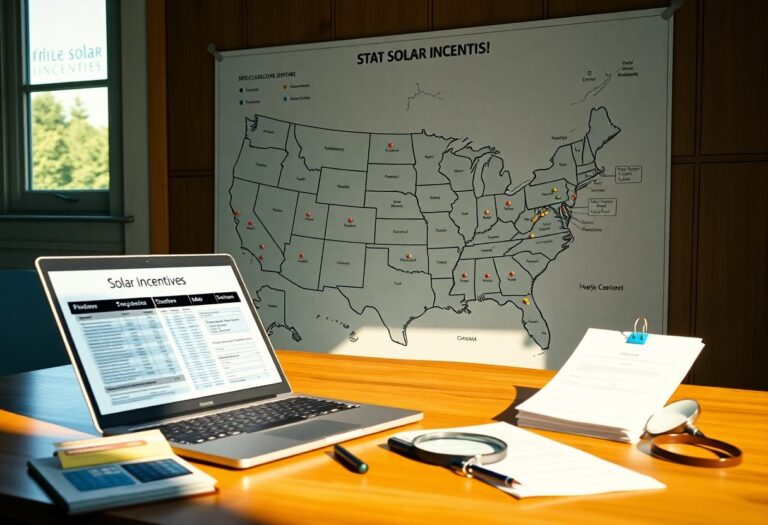

Solar incentives change by jurisdiction, so you need a clear map of state-specific rebates, tax credits, and net metering rules to maximize your savings; this hub guides you through policies, timelines, and application steps while flagging expiring programs and rollback risks that could cost you money, and detailing available federal and local incentives so you can plan installations, estimate payback, and select incentives that best fit your energy goals.
Key Takeaways:
- Incentives vary widely by state-differences in rebates, tax credits, net metering, and performance-based programs significantly affect project costs and payback periods.
- Federal, state, and local incentives often stack: combine the federal solar tax credit with state rebates, utility programs, and property tax exemptions to maximize savings.
- The hub centralizes eligibility, program details, and application links so homeowners and installers can compare offers, verify utility rules, and meet filing deadlines.
Overview of Solar Incentives
Federal, state, and local programs mix tax credits, rebates, net-metering and SREC/PBI schemes so you can offset installation costs and speed payback. The federal ITC covers up to 30% of system cost, while state rebates commonly range from a few hundred dollars to several thousand; however, policy shifts can cut export compensation sharply, altering returns in months or years.
Federal Incentives
The Investment Tax Credit (ITC) lets you deduct up to 30% of eligible solar equipment and installation from federal taxes; for a $20,000 system that’s roughly a $6,000 reduction. Businesses often combine the ITC with MACRS depreciation and may qualify for bonus credits tied to domestic content or energy-community location.
State-Level Programs
States offer rebates, performance-based incentives, SRECs and varying net-metering rules that change your annual savings. In some states SREC markets historically paid homeowners hundreds per MWh, while others use declining-block rebates (e.g., NY-Sun) or fixed per-kWh PBIs-making your site-specific analysis vital because incentives vary dramatically by state.
When you drill down, net-metering can be retail-rate credit, net billing with export rates based on avoided cost, or time-of-use differentials; California’s move to reduced export credits shifted payback timelines for many homeowners. Local utilities may add interconnection fees or size caps, and state rebate programs frequently use declining blocks, so early installers typically capture the largest incentives.
Northeast Region Solar Incentives
Across the Northeast, states pair fixed per-kWh tariffs, net metering, and financing tools to shape project economics; Massachusetts’ SMART program locks compensation for 10-20 years, while Connecticut’s C‑PACE can fund up to 100% of project costs. You should watch for utility-specific caps and declining incentive blocks, because sales and property tax exemptions plus performance payments can cut your upfront costs by thousands.
Connecticut
Connecticut maintains retail net metering, utility performance incentives, and commercial/multi‑family financing via C‑PACE, so you can finance a large system and repay through property assessments. For example, a 10 kW rooftop array in CT typically qualifies for net metering credits and utility rebate programs that reduce your upfront expense by several thousand dollars; monitor local utility block status and interconnection timelines to avoid surprise delays.
Massachusetts
Massachusetts relies on the SMART program for most new PV, offering fixed per‑kWh payments over 10-20 years plus retail net metering and state tax exemptions; a typical 6 kW residential system can hit payback in about 5-8 years depending on your electric rate and selected adders.
SMART awards are issued in declining blocks and include adders for storage, low‑income, brownfields, and municipal projects that can boost compensation by several cents per kWh; you should prioritize adder-eligible sites because blocks fill quickly and permitting/interconnection can take weeks to months, materially affecting cash flow and project timing.
Midwest Region Solar Incentives
Across the Midwest you’ll find a patchwork of programs that favor community solar subscriptions, strong interconnection rules, and property tax breaks; many states let you stack those incentives with the federal 30% ITC. Utilities often offer bill-crediting or performance-based payments, so you should evaluate local tariffs, community-solar availability, and state-driven rebate windows to optimize payback timelines and avoid losing capacity-based incentives.
Illinois
In Illinois you can tap the Illinois Shines adjustable-block framework and an expanded community-solar market created by FEJA, while most jurisdictions exempt added solar value from property tax assessments. You should compare REC or block rates by system size and developer category, then combine state incentives with the federal 30% ITC to reduce upfront costs and shorten typical payback windows.
Minnesota
Minnesota emphasizes community solar gardens and utility programs that let you subscribe for bill credits instead of hosting panels; net-metering-quality crediting and streamlined interconnection make on-site and off-site options workable. You should check Xcel and local co-op offerings, evaluate subscription pricing versus retail rates, and factor the federal 30% ITC into your financial model.
When you dig deeper in Minnesota, note that community solar subscriptions are structured so the utility applies generation credits to your retail bill monthly, often tied to project output or a fixed per-kWh credit; contracts typically run 10-25 years and can include transferability if you move within the same utility territory. Interconnection standards are relatively mature, so your installer can usually secure permission to operate within weeks, and utilities publish subscription waitlists and pricing tiers you should review to lock in the best effective credit rate.
Southern Region Solar Incentives
Texas
With Texas leading the nation in installed solar capacity (well over 10 GW), your options depend on location: there’s no statewide cash rebate, so you’ll rely on local deals-municipal utilities like Austin Energy and CPS Energy, plus many co-ops, offer tiered rebates and performance programs. Federal support still applies (30% ITC), and net metering policies vary by utility, meaning you should check buyback rates and interconnection rules before sizing your system.
Florida
Florida gives you powerful tax breaks-most systems qualify for a 100% property tax exemption on added home value and a sales tax exemption on equipment-so your up‑front costs drop significantly. Utility treatment of exported solar differs: many municipal and co-op utilities keep favorable net metering, while some investor‑owned utilities use alternative buyback mechanisms, so compare your utility’s tariff before you commit.
For a concrete example, if a 6 kW system in your Florida home costs $15,000, the 30% federal ITC reduces your net cost to about $10,500; combined with the tax exemptions and possible PACE or local financing, you could see payback in roughly 6-10 years depending on your electric rates. Also evaluate community solar options like investor programs and check your city’s permitting speed-fast permitting and lower soft costs can shave months and hundreds of dollars off your project.
Western Region Solar Incentives
Across the West you’ll encounter state programs from generous rebates to utility pilots; the federal 30% ITC still underpins project economics. California’s export cuts shift value into batteries, while Oregon and Washington maintain strong net‑metering for many utilities. Typical annual production ranges from 4-6 kWh per kW per day, so you should size systems and storage to match local TOU rates and wildfire‑resilience incentives.
California
In California NEM 3.0 reduced export compensation, so you’ll often recover most value by adding storage or shifting load. The Self‑Generation Incentive Program (SGIP) offers targeted battery incentives for resilience and equity projects, and the state provides a property‑tax exclusion for installed systems. Solar in Southern California can yield about 5-6 kWh per kW per day, increasing ROI when paired with the ITC.
Colorado
Colorado combines broad community solar options with utility‑specific net‑metering and interconnection rules, so you should compare Xcel, Black Hills, and cooperative tariffs. Solar resource on the Front Range averages roughly 4-4.5 kWh per kW per day, making rooftop systems competitive and community subscriptions attractive if you want to avoid upfront costs. Local rebates and pilot storage incentives vary by utility and county.
For example, a 6 kW rooftop system near Denver typically produces about 9,000-10,000 kWh/year; you can estimate savings by multiplying that by your retail rate. If your utility reduces buy‑back credits, pairing a battery improves economic returns and resilience during outages. You should check Xcel’s interconnection timeline and any pay‑for‑performance pilots before finalizing system size.
Special Programs and Rebates
State and utility special programs often target specific groups-low-income households, farms, battery add-ons-or offer point-of-sale rebates and performance payments; you can see rebates ranging from $0.50-$2.00 per watt or flat grants up to several thousand dollars. If you qualify for a $1/W rebate on a 6 kW system, for example, that’s an immediate $6,000 reduction in installed cost that shortens your payback dramatically.
Community Solar Programs
You can subscribe to community solar projects without installing panels, gaining bill credits through virtual net metering; programs in states like Minnesota and Colorado let you buy or lease a share and often save 5-20% annually versus retail rates. Minimum share sizes typically start around 1 kW, and some projects offer transferability if you move within the same utility territory, making community solar a flexible option for renters and shaded properties.
Utility-Specific Incentives
Utilities offer a mix of rebates, performance-based incentives, interconnection fee waivers, and net-metering rules that directly affect your returns; watch for changes like California’s NEM 3.0 that cut export compensation-an outcome that can be financially significant. When evaluating installers, compare offers that combine a per-watt rebate with favorable export crediting or time-of-use alignment to maximize your savings.
Digging deeper, you’ll find large differences between utilities: some still provide upfront rebates (e.g., $0.50-$1.50/W) while others favor ongoing payments per kWh exported or netting at retail rates. For instance, if you install a 7 kW system and secure a $1/W rebate plus net metering at full retail, your first-year cashflow improves substantially; conversely, if your utility shifts to wholesale export rates, expect longer payback and consider adding storage or load-shifting to capture value. Always check recent tariff filings and interconnection timelines for your utility-those procedural fees and export rules can be the most impactful variables for your project economics.
Conclusion
Ultimately you can use the Interactive Map of State Incentive Programs for Solar Energy to pinpoint rebates, tax credits, and net-metering rules in your state, so you can plan installations, assess payback timelines, and maximize the return on your solar investment.
FAQ
Q: What types of state-level solar incentives does the State-by-State Solar Incentives (Hub) list?
A: The Hub catalogs incentives including state tax credits, point-of-sale and post-installation rebates, performance-based incentives (SRECs, PBI), net metering or net billing policies, sales and property tax exemptions, low-income and community solar programs, PACE financing and on-bill repayment, utility-specific rebates and time-of-use rate adjustments, and grant/loan programs for schools and nonprofits. Each listing shows eligibility rules, program administrator, program caps and sunset dates, application deadlines, and any required documentation so users can assess financial impact and compliance requirements.
Q: How can I find and compare the incentives available in my state on the Hub?
A: Use the Hub’s state filter or map to view incentives for your state, then refine by incentive type (tax credit, rebate, PBI, etc.), customer class (residential, commercial, low-income), and utility territory. Compare estimated dollar value, expiration date, stacking rules, and administrative contact. Open each program page to view the official program statute or application link, sample forms, and recent program capacity utilization. Sign up for alerts on program changes and export comparison reports to share with installers or financial advisors.
Q: What are best practices for applying for and stacking state incentives with the federal tax credit and utility programs?
A: Confirm stacking rules for each incentive-some state programs reduce their benefit by the federal ITC amount while others allow full stacking. Obtain an itemized invoice from your installer that separates equipment cost, labor, and any eligible battery components; keep all receipts and interconnection approvals. Submit rebate applications according to program timing (pre-approval vs. post-installation) and enroll in PBI or SREC markets if applicable. For state tax credits, follow state tax filing instructions and retain documentation for audits. Check program caps and application windows, coordinate with your utility for net metering enrollment, and consult a tax professional for complex situations such as transferability, sale/transfer of credits, or commercial project depreciation.