
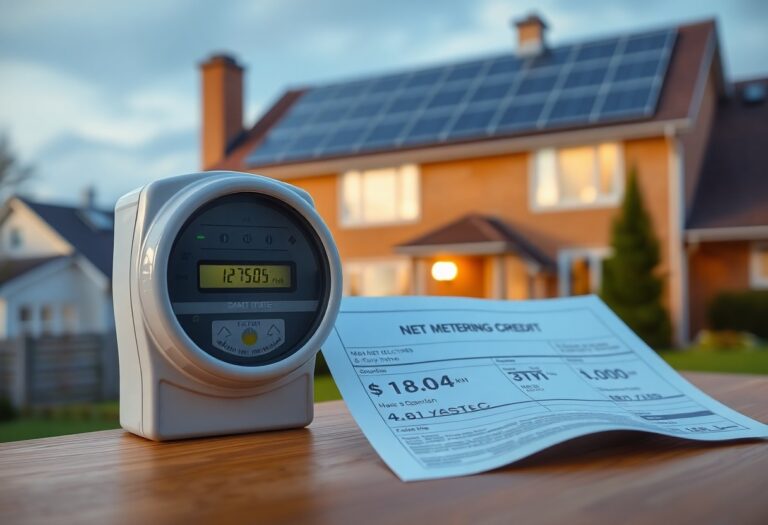

With net metering, your solar or generation system sends excess power back to the grid and you receive credits that can reduce or even eliminate your electric bill; how much you save depends on how your utility values exported energy. You should know that policies and rate structures vary and can reduce credits or add fees, which may increase costs over time. Understanding metering periods, billing cycles, and local rules lets you maximize benefits and avoid surprises.
Key Takeaways:
- Net metering credits excess on-site generation to your account, offsetting the electricity you draw from the grid at the utility’s compensation rate.
- Billing impact varies by program: retail-rate credits yield near-dollar-for-dollar savings, while net-billing, time-of-use rates or lower export prices reduce savings; annual true-ups determine final charges or credits.
- Savings depend on local policy, rate structure, system size and when you use power; adding storage, shifting loads to sunny hours, or facing export limits/fees alters the financial outcome.
Understanding Net Metering
Definition of Net Metering
Net metering lets you offset your electricity use by exporting excess solar generation to the grid and receiving credits on your bill, often at or near the retail rate; this can reduce or zero out monthly charges and shift your payback period by years. Utilities track flows with a bi-directional meter and apply credits during the billing cycle, with more than 30 states and many utilities offering variations that affect how and when you get paid.
Types of Net Metering Programs
You’ll encounter several program types: full retail net metering (1:1 credit), net billing (export paid at avoided-cost rates), buy-all/sell-all (all generation sold, all consumption bought), time-of-use adjusted credits, and aggregate netting across meters. Some utilities shifted credits from retail (~$0.12-$0.30/kWh) to avoided-cost levels (~$0.03-$0.08/kWh), changing economics for new systems and influencing system size decisions you make.
- Full retail net metering – you receive near 1:1 bill credit for exported energy.
- Net billing – exports are compensated at utility’s avoided-cost rate, often lower than retail.
- Buy-all/sell-all – your generation is sold to the grid and you buy back consumption separately.
- Time-of-use adjustments – credits vary by hour, rewarding exports during peak price periods.
- Knowing you should compare your utility’s credit rate, export limits, and monthly fees before sizing a system.
| Program Type | Impact on Your Bill |
| Full retail NEM | Maximizes bill offset; speeds payback |
| Net billing | Lower export credits; longer payback |
| Buy-all/sell-all | Separate metering of generation and consumption |
| Time-of-use NEM | Higher value for peak-hour exports |
| Aggregate netting | Offsets multiple meters under one account |
Digging deeper, utilities often pair program type with specific rules: interconnection fees, non-bypassable charges, and export caps (e.g., 100% of monthly generation or fixed kW limits). For example, California’s NEM changes introduced fixed connection charges and TOU periods that shifted savings by 10-30% for many customers. You should model annual savings under your local tariff and production profile to see real impacts on your payback and system sizing.
- Interconnection rules – fees and timelines that affect installation cost and delay.
- Export limits – caps on how much you can send back to the grid.
- Credit rate type – retail vs. avoided-cost dramatically changes revenue.
- Time-of-use pricing – shifts value toward exporting during peak demand hours.
- Knowing you must run a site-specific cashflow with local rates and production data before committing.
| Feature | Example / Effect |
| Interconnection fee | $50-$500 one-time, varies by utility |
| Export compensation | Retail (~$0.12-$0.30/kWh) vs avoided (~$0.03-$0.08/kWh) |
| Export cap | May limit to system size or kW exported |
| TOU rates | Premiums during peak hours raise export value |
| Contract term | Some programs use fixed tariffs or gradual step-downs over 10-20 years |
How Net Metering Works
The Metering Process
Your rooftop array exports surplus to the grid while your meter records both directions; a typical 5 kW system can produce about 20-30 kWh/day in sunny regions, so daytime exports and nighttime imports often balance over a month. Utilities use bidirectional or smart meters that log flows hourly, letting them net exports against imports for each billing cycle. If your plan has time-of-use pricing, those hourly records determine whether exported energy earns peak or off-peak value.
Energy Credits and Billing
When you export more than you import, the utility converts that excess into credits shown as kWh or dollars on your bill; for example, exporting 200 kWh and importing 150 kWh yields a 50 kWh credit carryover. Some utilities keep parity with the retail rate, but others settle leftover credits at the avoided-cost rate (~$0.02-$0.05/kWh) during annual reconciliation. Also, fixed charges, taxes, and minimum monthly fees usually remain on your bill even if energy charges drop.
Over a year you might hit an annual true-up: say your system generates 6,000 kWh and you consume 5,400 kWh, leaving a 600 kWh surplus. If the utility cashes out at $0.03/kWh you’d receive $18 instead of full retail value, or you could apply that 600 kWh against next year’s usage. Check your tariff to see whether credits roll monthly or are cashed out at year-end so you can plan system size and finances accordingly.
Benefits of Net Metering
Net metering lets you turn surplus generation into bill credits, directly reducing your electric charges and accelerating system payback. In many states homeowners recover solar costs in 5-10 years, and pairing panels with batteries or EV charging can further increase returns. You also gain protection against utility rate hikes since exported kWh offset future consumption at credited rates – though exact value depends on local tariff design and eligibility rules.
Cost Savings for Homeowners
If your utility offers retail-rate credits, each kWh you export typically offsets a kWh you consume later, so your monthly bill falls dollar-for-dollar. Producing during midday under time-of-use tariffs helps you avoid high evening rates, which in some cases improves payback by 30-50%. When compensation drops to wholesale levels, you may need storage or load-shifting strategies to capture the same savings.
Environmental Impact
Distributed solar under net metering displaces marginal fossil generation and lowers emissions; in the U.S. each kWh of solar avoids roughly 0.9 lb CO₂. A typical 6 kW rooftop system producing ~8,000 kWh/year can cut about 3.3 metric tons of CO₂ annually, helping you shrink your household’s carbon footprint while supporting cleaner grid mixes.
You also help grid reliability and defer some infrastructure costs by reducing peak demand, but high solar penetration creates issues like the duck curve-midday oversupply followed by steep evening ramps. You can mitigate that by adding batteries or smart EV charging so exported energy is stored and used during ramps; policy and storage incentives in states like California show this combination delivers the best environmental and system-level outcomes.
Potential Drawbacks of Net Metering
Net metering can shift costs and operational burdens onto non-solar customers and utilities, so you may see higher fixed charges or new demand fees as utilities recover grid upkeep. At high solar penetration, intermittent exports create voltage and balancing challenges that require investment in storage, smarter inverters, or grid upgrades. Policy uncertainty and credit reductions can also suddenly lengthen your system payback, making projections you relied on less accurate.
Energy Dependence and Grid Reliability
Because rooftop solar produces most power midday, you might still rely heavily on the grid during evenings and cloudy days, exacerbating the “duck curve” ramping problem. Rapid drops in PV output can force system operators to dispatch fast-ramping gas or battery resources; for example, CAISO experienced ramps of roughly ~13 GW over a few hours in earlier studies. Local reverse flows can stress transformers and protection schemes unless you or your utility upgrade equipment.
Policy Changes and Regulatory Issues
Regulators frequently revisit compensation structures, so your expected export credit can be reduced or replaced by time-varying or avoided-cost rates; when that happens, your projected savings and payback period can increase sharply. Retroactive or phased-in changes-like moves from retail-rate credits to lower avoided-cost values-have prompted litigation and installer market shifts in several states.
For example, when some states moved export compensation from near-retail levels (~$0.20-$0.30/kWh) to avoided-cost ranges (~$0.03-$0.05/kWh), analyses showed residential payback periods lengthening from typical 6-9 years to 10-15+ years for many owners. You can mitigate regulatory risk by applying before deadline-based tariff changes, pairing panels with battery storage or smart dispatch to maximize self-consumption, or choosing leases/PPAs that include regulatory protections. Keep following your state utility commission dockets and local utility filings-policy timing and grandfathering rules often determine whether you keep favorable rates.
Net Metering Policies by State
Across the U.S., policy details change by state and utility, so what you pay or get credited for exported solar can vary widely. In some states you still receive full retail credit per kWh, while others moved to time-of-use or export-only rates after reforms like California’s NEM 3.0. If you live in Hawaii, Massachusetts, or New Jersey, incentives and tariffs look very different than in Texas or Florida, affecting system sizing and payback timelines.
Overview of State Regulations
States use three common models: true net metering (credit at retail), net billing (export paid at an avoided-cost or time-varying rate), and buy-all/sell-all. Typical retail rates run about 12-30¢/kWh, while avoided-cost export credits often fall to 2-10¢/kWh. You should check for program caps, interconnection size limits and mandatory demand charges; these rules determine whether solar reduces your bill immediately or mainly offsets future usage.
Incentives and Rebates
Beyond net metering, states and utilities offer upfront rebates, performance-based incentives, and tax credits that change economics. The federal Investment Tax Credit can lower your system cost by up to 30%, and programs like Massachusetts’ SMART or New York’s NY-Sun add per-kWh or upfront support that cuts payback by years. You’ll want to stack state incentives with federal credits to maximize savings.
Many incentives are location-specific: some utilities pay production-based rates for the first 5-10 years, while others offer one-time rebates per watt installed. Lookup resources such as the DSIRE database and contact your utility tariff for exact numbers; local rules often determine whether adding batteries or increasing system size is worth it for your bill reduction and export compensation.
How to Get Started with Net Metering
Contact your utility for the specific net metering tariff, interconnection forms, and true-up date. Use your last 12 months of bills to calculate average demand – the U.S. household uses about 877 kWh/month – then size a system (commonly 4-8 kW) to offset that load. Obtain permits, compare three quotes, and anticipate payback of 5-10 years depending on incentives.
Assessing Your Energy Needs
Analyze 12 months of bills for monthly kWh, peak charges, and time‑of‑use rates, and pull hourly data from your smart meter or utility portal. If you add an EV, plan for roughly 3,000-4,000 kWh/year more; a 5 kW system typically produces ~6,000-8,000 kWh/year depending on location. Size panels to match your load and avoid oversizing that may trigger higher interconnection fees.
Choosing the Right Solar Provider
Vet installers for state licensing and NABCEP certification, check at least three references, and compare proposals line‑by‑line. Insist on a written warranty covering 25‑year performance and 10‑year workmanship. Expect installer prices around $2.50-$3.50/W before incentives; financing choice (PPA, loan, cash) will alter your cashflow and payback timeline.
Make sure you scrutinize the contract for escalation clauses, production guarantees, and termination or assignment terms; require a monitoring portal and an insurance certificate naming you as additional insured. For example, a homeowner in Arizona who insisted on a 95% production guarantee achieved ~12% higher annual output than neighbors and recouped costs in six years after state rebates.
Final Words
From above you can see how net metering lets you offset grid consumption by exporting surplus solar energy, lowering your energy bills and improving system payback; policy specifics affect rates, credits and billing cycles, so review local rules like Massachusetts Solar Net Metering to understand how your savings and billing will be calculated.
FAQ
Q: What is net metering and how does it work?
A: Net metering is a billing arrangement that lets customers with on-site generation (typically rooftop solar) offset their electricity consumption by sending excess production back to the grid. During a billing period your meter records total energy consumed minus total energy exported; if you produce more than you use, the surplus is credited to your account. Implementation varies by utility and jurisdiction – some meters literally run backward when you export, while others record imports and exports separately and calculate a net value at the end of the billing cycle.
Q: How does net metering affect my electric bill?
A: Net metering lowers the amount of energy you buy from the utility by applying production credits against consumption, reducing the kWh portion of your bill. If credits are issued at the retail rate, each exported kWh offsets a purchased kWh dollar-for-dollar; if credits are at a lower wholesale or avoided-cost rate, the savings per exported kWh are smaller. Netting can produce three typical outcomes on a bill: you owe the utility because your usage exceeded production; your production and usage balanced and you owe little or nothing except fixed charges; or you earned a credit that carries forward (or is paid out or expires) depending on local rules. Fixed monthly fees, demand charges, taxes, and interconnection fees are usually still billed separately and may limit total savings.
Q: What factors determine how much I save and how can I maximize benefits?
A: Savings depend on system size vs. household consumption, orientation and shading of panels, local net metering policy (credit rate, carryover rules, expiration), utility rate structure (time‑of‑use pricing, demand charges), and whether battery storage is used. To maximize benefits: size the system to match annual usage rather than peak output; shift discretionary loads to daytime production hours under retail credit or TOU pricing; review your utility’s compensation method-retail credits yield the highest straightforward savings; consider adding storage if exports are credited poorly but TOU or peak charges make shifting valuable; and check net metering caps, interconnection costs, and credit expiration so you don’t oversize and lose value on exported energy.