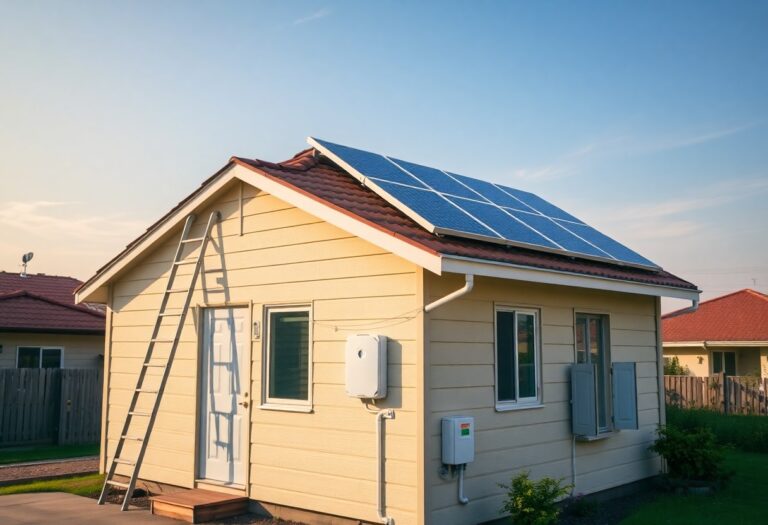

Over the past decade solar has become a viable option for small homes, and if you value long-term savings you should weigh significant electricity bill reductions against the high upfront cost and potential for poor installation; when sized properly, systems can deliver energy independence and increased home value, but you must assess roof suitability, local incentives, and payback timelines to decide if solar fits your budget and goals.
Key Takeaways:
- Strong savings potential when a small home’s consumption is moderate-to-high and roof orientation/space allow an adequately sized system; many owners can offset most or all electricity use.
- Financial viability depends on local electricity rates, incentives, and installation costs-net metering and rebates can shorten payback to about 5-10 years, while absent incentives payback may be longer.
- High-efficiency panels, microinverters, or community solar make limited roof space workable; batteries are worthwhile only if backup or time-of-use savings justify the added expense.
Understanding Solar Energy
For a small home you should know that a typical system size ranges from 3-8 kW, often requiring 8-24 panels depending on panel wattage (300-400 W each). Energy use for small homes usually runs about 4,000-8,000 kWh/year, so a 5 kW system can generate roughly 5-7,000 kWh/year in sunny regions. You’ll want to weigh upfront costs, incentives and a typical payback of 5-12 years, plus the fact that panels last 25-30 years with ~0.5% annual degradation.
What is Solar Energy?
Solar energy converts sunlight into electricity with photovoltaic (PV) cells made from silicon; you get direct-current (DC) power from cells that an inverter then converts to usable alternating current (AC). Residential panels average 15-22% efficiency, and output per installed kilowatt varies by location – roughly 3-6 kWh/day per kW in the U.S. This means your system size and local sun hours directly determine how much of your home’s demand you can offset.
How Solar Panels Work
Panels are arrays of PV cells wired into modules, mounted on racking, and connected to an inverter and meter; batteries are optional. String inverters are common, while microinverters or power optimizers improve performance on partially shaded roofs. Typical panel output is 300-400 W, and inverter efficiency runs ~95-98%. You must watch for shading and roof orientation, since even small shade can cut system output dramatically and is one of the most dangerous performance issues.
At the cell level, photons knock electrons across a p-n junction to create DC current; panels wired in series increase voltage while parallel strings increase current. Maximum power point tracking (MPPT) in modern inverters extracts optimal power throughout the day. Expect warranties around 25 years, ~0.5% annual degradation, and system losses (wiring, inverter) of ~10-15%. If you pair batteries, factor in round-trip efficiency (~80-90%) and different economics versus grid-tied net metering.
Benefits of Solar Energy for Small Homes
You gain lower bills, increased home value, and backup power options without oversized systems; a typical small-home array is 3-5 kW and fits easily on compact roofs. Incentives like the 30% federal tax credit and local rebates often cut upfront costs, while simple maintenance keeps ongoing expenses low. You also get resilience during outages with batteries (optional) and a faster resale advantage-many sellers recover installation costs through higher sale prices or quicker listings.
Cost Savings on Energy Bills
You can cut your electricity costs by replacing grid purchases: a 3-5 kW array commonly offsets 60-100% of a small home’s usage (roughly 6,000-8,000 kWh/yr), saving about $600-$1,500/year depending on rates. After applying the 30% federal tax credit and local incentives your net payback often lands between 6-10 years, with decades of reduced bills afterward; adding a battery increases upfront cost by roughly $5,000-$15,000.
Environmental Impact
You immediately lower your carbon footprint: a properly sited 3-5 kW system typically avoids ~2-5 metric tons CO2/year depending on your grid mix, cutting smog-forming pollutants too. Life-cycle studies show panel manufacturing emissions are usually recovered within 1-3 years of operation, so your system becomes a net environmental benefit for the remainder of its 25+ year lifespan.
For perspective, avoiding 2-5 metric tons/year is roughly equivalent to removing ~0.4-1.0 average U.S. passenger cars from the road annually (EPA avg ~4.6 t/yr). You should weigh battery choices carefully: while storage boosts resilience, batteries carry sourcing and end-of-life disposal concerns and typically last 10-15 years, though recycling programs and second-life markets are scaling up to reduce those impacts.
Costs and Considerations
Upfront and ongoing expenses determine whether solar pays for your small home. For a typical 3-5 kW system costs run about $2.50-$3.50 per watt before incentives, translating to roughly $7,500-$17,500; with the 30% federal tax credit that drops substantially. Local rebates, net metering rules, and your electric rate can push payback into the 5-10 year range in many markets, so model savings using your actual bills and site-specific production estimates.
Initial Investment and Installation
You’ll cover panels, inverters, racking, permits and labor. A 4 kW system at $3.00/W is about $12,000 pre-credit-after the 30% ITC that’s roughly $8,400 out of pocket. Roof condition can add $1,000-$5,000 for repairs or specialized mounting; ground mounts increase permitting and labor. Get three bids, verify NABCEP or equivalent certifications, and demand performance estimates tied to your address to size the system to your actual usage.
Maintenance and Longevity of Solar Panels
Panels mostly require minimal upkeep: annual or biannual cleaning typically costs <$strong>150 for a pro (you can DIY cheaper), and monitoring catches drops in output quickly. Expect the inverter to be the main replacement at ~10-15 years (approx. $1,000-$2,500), while panels carry 25-year warranties and generally degrade about 0.5% per year, leaving you with ~80-90% output at year 25.
For more detail, note that system production depends on location and orientation-a 4 kW setup in a sunny area like Phoenix can yield ~6,000-7,000 kWh/yr, substantially offsetting a small home’s load. If you choose microinverters or power optimizers, you’ll see longer-lived module-level hardware (25+ year expected) versus a single string inverter which often needs swapping once during the system lifetime. Also account for minor insurance increases (~$50-$150/yr), seasonal cleaning in dusty or snowy climates, and the fact that poor installation not only cuts savings but raises fire and performance risks, so prioritize certified installers and clear, monitored warranties.
Financial Incentives and Rebates
Government Grants and Tax Credits
The federal Investment Tax Credit (ITC) currently provides a 30% credit against your solar system cost, directly reducing your tax bill; for example, a $12,000 4 kW install falls to $8,400 after the credit. The Inflation Reduction Act added bonus incentives for projects meeting domestic‑content, energy‑community, or low‑income criteria, which can increase savings. If you don’t have enough tax liability to use the ITC, many states and nonprofits offer upfront grants or point‑of‑sale rebates-commonly between $500 and $3,000-that lower your out‑of‑pocket cost.
Local Utility Incentives
Many utilities provide per‑watt rebates, performance payments, or net‑metering structures that affect your payback. You can see per‑watt rebates of $0.10-$0.50/W (so a 5 kW system at $0.40/W nets $2,000), while exported energy credits range from full retail to avoided‑cost rates (often 3-12¢/kWh). Check your utility’s interconnection fees, time‑of‑use rates, and whether community solar or co‑op programs offer better terms for small homes.
Dig deeper into your utility tariff: some utilities pay performance‑based incentives of roughly $0.02-$0.06/kWh for installed solar over 5-10 years, while others limit credits to avoided‑cost cents. A practical comparison: if your utility credits exports at $0.18/kWh and you export 2,000 kWh/year you get $360/year; at $0.04/kWh you’d get $80/year – a $280/year gap that can extend payback by several years on a small system. Also check program caps, application windows, and whether interconnection fees are waived.
Evaluating Your Home’s Solar Potential
A quick site assessment identifies constraints: roof age, structural capacity, shading and available square footage. Use local solar insolation-roughly 4-5 kWh/m²/day in many U.S. regions-to estimate output; for example a 4 kW system typically yields about 4,800-6,000 kWh/year. Check your panel orientation, electrical panel, and local incentives or rebates, since incentives can cut payback from a decade to under 5-7 years in generous jurisdictions.
Roof Orientation and Sunlight Exposure
South-facing roofs in the Northern Hemisphere maximize output, producing up to 10-25% more than east/west installations depending on tilt. Tilt near your latitude gives year-round balance; a flat roof or low pitch may need racking. Even small shade from trees or vents reduces yield dramatically-> 30% shading often makes panels uneconomical. Consider panel-level optimizers or microinverters to limit shading losses and split arrays across orientations to match morning or afternoon demand.
Energy Consumption Patterns
Analyze 12 months of bills to see seasonal and peak usage; many small homes run ~400-800 kWh/month, while homes with EVs or heat pumps can exceed 1,200 kWh/month. If most consumption occurs in evenings, a solar system without storage will export midday surplus and import at night, lowering self-consumption. Time-of-use rates, net metering and demand charges change economics, so size your array to offset daytime loads or pair with batteries to shift solar energy to peak hours.
For a practical sizing example, if your household uses 30 kWh/day (≈900 kWh/month), a 5 kW system in a 4-hour sun region produces ~20 kWh/day, covering about two-thirds of demand; pairing a 10 kWh battery can shift excess midday solar to cover evenings. Prioritize offsetting high-cost periods: under typical tariffs, increasing self-consumption from 20% to 60% can shorten payback by several years, and net metering policies greatly affect whether you should oversize or constrain the array.
Choosing the Right Solar System
Types of Solar Panels
When comparing panel technologies for a small roof, you’ll weigh efficiency, cost per watt, degradation and roof-area limits: monocrystalline delivers ~18-22% efficiency and suits tight roofs, polycrystalline runs ~15-17% at lower cost, and thin-film offers lightweight flexibility but lower output. Thou should compare manufacturer warranty lengths (standard 25 years for output) and real-world temperature coefficients before deciding.
- Monocrystalline
- Polycrystalline
- Thin-film
- Efficiency
- Warranty
| Monocrystalline | ~18-22% efficiency; best if you have limited roof area; higher cost but better long-term yield. |
| Polycrystalline | ~15-17% efficiency; lower upfront cost; suitable when you have ample roof area. |
| Thin-film | <12% efficiency; light and flexible for unconventional roofs; you'll sacrifice output for form factor. |
| Bifacial | Can add ~5-15% extra energy if you have reflective surface or elevated racking; ideal for ground mounts or tilted arrays. |
| PERC / HJT (advanced cells) | Improved low-light and temperature performance; you may gain 1-3% more annual yield versus standard cells. |
Selecting a Installation Company
Choose an installer that is licensed, insured, and offers transparent, itemized quotes; look for NABCEP certification or regional equivalents, ask for performance estimates using your actual roof orientation, and expect typical small-home installs (3-5 kW) to be completed in 1-3 days on-site. Thou should verify a written workmanship warranty (often 2-10 years) and documented references from local installs.
Dig into the contract details: confirm who handles permits and interconnection, whether the company provides a production guarantee or monitoring platform, and how they address roof penetrations and flashing. Use at least three detailed bids to compare assumed panel models, inverter types (string vs microinverters), expected annual kWh production, and proposed timelines-permits commonly add 2-8 weeks. Ask for proof of liability and workers’ compensation insurance, check online reviews for installation quality, and prioritize firms that include a clear post‑install inspection and expedited warranty response process so your system stays productive for decades.
To wrap up
Conclusively, solar can make strong financial and practical sense for small homes if you assess your energy needs, your roof or portable array space, and your budget; you can lower utility costs, increase resilience, and pair systems with batteries for overnight use. For sizing guidance and realistic expectations see Solar Power for Tiny Houses: How Much Do You Need?
FAQ
Q: Is solar cost-effective for small homes?
A: Small homes often need smaller systems (commonly 2-6 kW), which lowers upfront cost and can produce a high return if local electricity rates are high or generous net metering exists. A rough rule: 1 kW of panels yields about 1,000-1,500 kWh/year depending on location, so a 4 kW system might generate 4,000-6,000 kWh/year. Typical simple payback for small-home systems ranges from about 5-15 years after federal and state incentives; adding batteries increases costs and usually lengthens payback. Long-term savings come from reduced utility bills, avoided rate increases, and increased home value, while ongoing costs are limited to inverter replacement (often 10-15 years) and minimal panel maintenance.
Q: What factors determine whether solar is a good fit for my small home?
A: Key factors are roof area, orientation (south-facing in the northern hemisphere is best), and shading from trees or buildings; even a small shaded roof can significantly reduce output. Local electricity price and net metering policy affect financial returns-higher retail rates and full retail net metering increase savings. Available incentives (federal tax credits, state rebates, local incentives), financing terms, and whether you own or plan to sell the home soon also matter. Roof condition, HOA rules and permitting timelines influence installation feasibility and costs. Energy-efficiency upgrades and reducing load before sizing a system improve economics.
Q: How do I calculate whether solar is worth it for my home?
A: Steps: 1) Find your annual electricity use (kWh/year) from bills. 2) Estimate local panel output per kW (use 1,000-1,500 kWh/kW as a location-dependent guide). 3) Desired system size = target annual production ÷ output per kW. 4) Multiply system size by installed cost per watt to estimate gross cost, then subtract applicable incentives (federal tax credit-30% for eligible systems as of 2024 in many cases-and any local rebates) to get net cost. 5) Annual savings = system annual production × your electricity rate (include net metering credits if applicable). 6) Simple payback = net cost ÷ annual savings; factor in inverter replacement, minor maintenance, and panel degradation (≈0.5-1%/year) for longer-term ROI. Example: 6,000 kWh/year target ÷ 1,200 kWh/kW ≈ 5 kW system; at $3.00/W gross cost ≈ $15,000, minus 30% tax credit → $10,500 net; annual savings at $0.18/kWh = $1,080 → ~9.7-year payback.