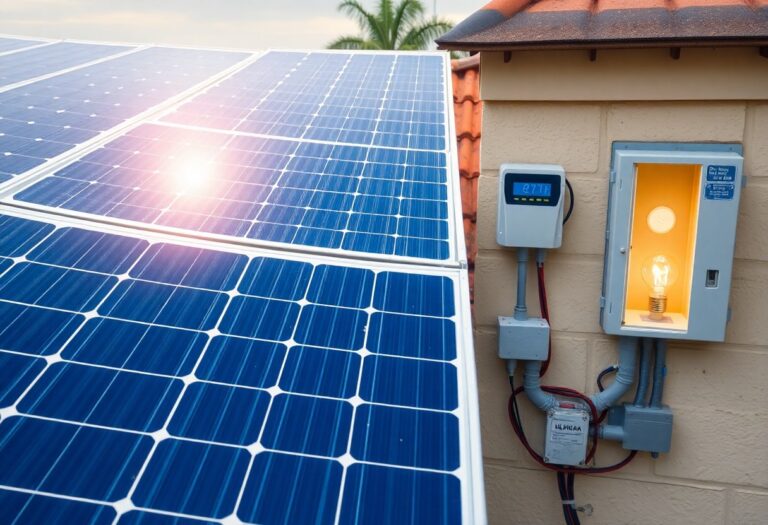

Many solar panels use silicon cells where incoming photons free electrons, creating a flow of charge you capture as DC electricity; an inverter then converts that to AC for your appliances, and system design, shading, and panel orientation determine efficiency, while poor wiring or incorrect installation can create fire risks you must avoid.
Key Takeaways:
- Photons hitting a solar cell excite electrons in silicon, creating electron-hole pairs that are separated by the cell’s internal electric field at the p-n junction.
- Separated electrons flow as direct current through an external circuit; an inverter converts that DC into usable alternating current for homes and the grid.
- Panel output depends on sunlight intensity, angle, temperature, and shading-array design and system components (inverter, wiring) determine real-world efficiency.
Understanding Solar Panels
You can trace a module’s performance to how its silicon cells, glass, encapsulant, frame and electronics interact; typical rooftop modules deliver 250-400 W and efficiencies from 15-22%, while poor installation or shading can create hot spots that increase fire risk. Measurement data from a 6.6 kW residential system shows ~8,000-10,000 kWh/year in sunnier climates, so you should weigh location and tilt when estimating output.
| Photons → | Electron excitation in silicon cells; creates DC current |
| Solar cells | Monocrystalline/polycrystalline/thin‑film; cell efficiency 10-22% |
| Glass & coating | Tempered, anti‑reflective glass protects and boosts light capture |
| Encapsulation | EVA or PVB seals cells against moisture, affects longevity |
| Electronics | Junction box, diodes, inverter/MPPT convert DC to usable AC |
Components of Solar Panels
Your panels are assemblies of distinct parts: the cells (often 60 or 72 per module), tempered glass, encapsulation layers, backsheet, aluminium frame and the junction box with diodes and connectors; each influences weight, durability and output – for example, a 60-cell 300 W mono module typically weighs ~18-20 kg and degrades ~0.5%/year.
- Cells – active semiconductor elements
- Glass – protection and light transmission
- Encapsulant – moisture barrier (EVA/PVB)
- Frame – mounting and structural support
- Junction box – electrical output, bypass diodes
Perceiving how a single component failure, like a torn backsheet or a faulty diode, reduces system performance helps you prioritize inspections.
| Cell count | Common: 60/72 cells; affects voltage and size |
| Cell type | Mono vs poly vs thin‑film; impacts efficiency and cost |
| Encapsulant | EVA typical; UV stability affects lifetime |
| Frame & glass | Aluminium frame + 3.2-4 mm tempered glass common |
| Electrical | Bypass diodes, junction box, MC4 connectors, IP65-IP68 ratings |
Types of Solar Panels
You’ll choose between monocrystalline (highest efficiency, ~18-22%), polycrystalline (~15-17%), thin‑film (CdTe/CIGS, ~10-13% but lightweight), bifacial (captures albedo for +5-15% yield) and BIPV integrated options; each has different temperature coefficients, degradation rates and upfront costs that affect system ROI and site suitability.
- Monocrystalline – high efficiency, premium cost
- Polycrystalline – lower cost, moderate efficiency
- Thin‑film – flexible, lower efficiency
- Bifacial – gains from reflected light
- BIPV – integrated into building materials
Perceiving the trade‑offs in efficiency, temperature sensitivity and lifecycle cost will guide which panel type meets your performance and budget goals.
| Monocrystalline | 18-22% eff.; low degradation (~0.4-0.6%/yr) |
| Polycrystalline | 15-17% eff.; lower cost, slightly worse temp coefficient |
| Thin‑film (CdTe/CIGS) | 10-13% eff.; better low‑light performance, flexible |
| Bifacial | +5-15% energy from rear side depending on albedo |
| BIPV | Integrates into façades/roofing; aesthetic and space‑saving |
In practice, you’ll match panel type to site: a south‑facing 6 kW rooftop in Arizona often uses monocrystalline for max kWh/area, while a large ground‑mount farm may favor polycrystalline for lower capex; field data shows bifacial arrays on white surfaces can increase annual yield by 10-12%, improving payback time in high‑insolation regions.
- Site match – orientation, shading and albedo matter
- Cost vs yield – balance upfront price and lifetime kWh
- Temperature coeff. – affects hot‑climate performance
- Degradation – typical 0.4-1%/yr depending on tech
- Warranty – 10-25 years common for product and output
Perceiving the long‑term degradation and warranty terms helps you calculate realistic energy production and return on investment.
| Site example | 6 kW mono rooftop → ~8,000-10,000 kWh/yr in high sun |
| Bifacial gain | White rooftop or snow: +5-15% annual yield |
| Temp effect | Coeff. −0.3 to −0.5%/°C; hotter reduces output |
| Degradation | Manufacturer rates 0.4-1%/yr; affects 25‑yr output |
| Economic metric | Levelized cost depends on panel cost, yield, incentives |
The Science of Photovoltaics
Beneath each module the key is energy conversion at the atomic level: photons with energy above silicon’s bandgap (about 1.12 eV) create electron-hole pairs, and your cell’s architecture collects those carriers before they recombine. Commercial crystalline modules typically deliver 15-22% efficiency, with top-of-line manufacturing and passivation pushing those numbers higher and laboratory single-junction cells exceeding 26%, illustrating how materials and processing directly affect your system’s yield.
How Photovoltaic Cells Work
When sunlight strikes a cell, an anti‑reflective coating and surface texturing maximize absorption while a p-n junction produces an internal electric field that separates electrons and holes; you then route the collected electrons through metal contacts to do work. Each silicon cell gives about 0.5-0.6 V, so a typical 60‑cell module yields ~30-36 V, and arrays wired in series can create 300-600 V DC
Doping creates the n‑type and p‑type regions that form the built‑in field; you benefit from optimized dopant levels (often around 10^15 cm^-3 in bulk) and long minority‑carrier lifetimes to extend diffusion lengths (~hundreds of micrometers) so more photogenerated carriers reach the junction. Advances like rear passivation and selective contacts help reduce recombination, meaning your cell converts a larger share of absorbed photons into usable current. Advanced semiconductor engineering targets loss mechanisms: Shockley‑Read‑Hall, Auger and radiative recombination are minimized by high‑quality crystalline silicon, surface passivation and impurity control. You should note that microcracks in wafers can create hotspots and rapid degradation (a dangerous failure mode), while technologies such as PERC, TOPCon and HJT have demonstrably improved production efficiencies and temperature performance by cutting rear‑surface and contact losses. You observe photons with energy above silicon’s bandgap (≈1.12 eV) creating electron-hole pairs inside the cell; an internal electric field at the p-n junction then separates charges, while wiring and diodes route the resulting DC to your inverter. Typical commercial modules convert about 15-22% of sunlight to electricity (advanced cells reach ~26-29%), and high operating temperatures can cut output by ~0.3-0.5% per °C, so thermal effects and resistive losses meaningfully limit real-world yield. When sunlight hits your panel, an anti-reflective coating and surface texturing reduce reflection from roughly 30% down to 2-5%, letting more photons enter the ~150-200 µm silicon wafer where absorption depends on wavelength; photons longer than ~1,100 nm pass through without creating carriers. Manufacturers increase optical path with microtexturing and thin-film back reflectors to trap light, and you should know that cell thickness and material quality set how many generated carriers survive to become current. Charge separation happens at the p-n junction: built-in electric fields drive electrons to the n-side and holes to the p-side, producing a voltage of about 0.5-0.6 V per cell; strings of ~60 cells give panel voltages around 30-36 V under load. When you close the circuit, collected carriers become a measurable current limited by recombination, series resistance and illumination level, so cell design and contacts determine how much of the generated charge becomes usable power. Diving deeper, recombination types-bulk, surface, and at grain boundaries-are quantified by minority-carrier lifetime and diffusion length (often tens to hundreds of micrometers), which control collection efficiency; for example, high-purity wafers with diffusion lengths >200 µm yield noticeably higher currents. You also contend with series/shunt resistances and use MPPT electronics to extract maximum power; note that a 300 W STC panel typically peaks at 1000 W/m² and 25°C, but a −0.4%/°C temperature coefficient can reduce that output significantly on hot roofs. Managing intermittent solar output means you’ll need storage choices that match your use patterns: electrochemical batteries, thermal tanks for water heating, or grid-scale options like pumped hydro. For example, Li‑ion batteries deliver roughly 85-95% round‑trip efficiency while pumped hydro is around 70-85%. A typical 5 kW residential PV system is often paired with 10-20 kWh of battery to cover evening loads, but you must account for thermal runaway and fire risk when sizing and siting systems. You should evaluate chemistry, usable capacity, and cycle life: LFP (LiFePO4) batteries often exceed 6,000 cycles and are safer than older chemistries, while conventional lithium‑ion gives 3,000-5,000 cycles. Commercial examples include the Tesla Powerwall (13.5 kWh usable, ~90% round‑trip) and systems sized to provide 4-12 hours of backup. Pay attention to depth‑of‑discharge limits, temperature derating, and installation clearances to reduce safety and performance risks. Grid‑tied setups let you export surplus power to the utility and import when needed; many markets offer net metering or feed‑in credits, though rates vary by policy (California’s recent NEM reforms are one example). They’re cost‑effective because you offset bills without buying a battery, but they won’t provide backup during outages unless you add storage, and export rules or interconnection requirements can limit how much you can send back to the grid. Technically, grid‑tied inverters must synchronize voltage and frequency with the grid and implement anti‑islanding shutoff to protect line workers during outages. Utilities often require an interconnection agreement, a bidirectional meter, and may impose export limits or curtailment during peak generation. You’ll encounter settings like export caps (e.g., limiting exports to a percentage of inverter rating) and mandatory testing, so plan permitting and inverter configuration early to avoid delays. Assessing environmental impacts shows both significant benefits and trade-offs; over its lifecycle PV typically emits 20-50 g CO2e/kWh, about 90% less than coal, so a 6 kW rooftop system producing ~9,000 kWh/yr can cut roughly 4-5 tonnes of CO2 annually. You should also account for upstream effects from mining silicon, silver and other materials, plus end-of-life handling and recycling needs that can create local environmental pressures. When you adopt solar, you gain major greenhouse gas reductions, near-zero operational emissions, and much lower water use than thermoelectric plants. For instance, a typical 5 kW residential array in the U.S. offsets about 3-4 tonnes of CO2 per year and can reduce your grid purchases by 50-80%, shielding you from volatile wholesale electricity prices. You need to balance benefits against real constraints: utility-scale PV requires roughly 3 acres per MW, and module production relies on materials like silver, indium and aluminium that have extraction impacts. Certain thin-film technologies contain hazardous materials like cadmium, and pairing solar with batteries increases lifecycle emissions and disposal challenges you must manage. Recycling and end-of-life planning matter: global PV recycling capacity currently lags deployment, so you should secure take-back or manufacturer warranty terms. Battery systems complicate this further-advanced recycling can recover >90% of cobalt and nickel in optimal processes, but actual rates vary; policies such as the EU WEEE/Battery rules are tightening requirements and will influence your long-term costs and compliance. When evaluating solar you must weigh upfront cost against lifetime savings and local policies; in the U.S. installed prices typically run around $2.5-$3.5 per watt, so a 6 kW array costs roughly $15,000-$21,000 before incentives. You can finance, lease, or use a PPA to reduce initial outlay, and typical payback periods fall between about 6-12 years depending on your electricity price and net metering rules. Installation breaks down into module, inverter and racking hardware plus soft costs: permitting, labor, and interconnection. Panels and inverters often occupy 50-70% of hardware costs, while soft costs can be 20-40% of the total. You should factor roof condition-replacing a roof can add $2,000-$8,000 and may affect timing or warranties-so site complexity directly changes your final installed price. You capture long-term value from avoided utility bills and policy incentives: net metering or feed-in credits, state rebates, and federal tax credits up to 30% cut capital costs. For example, at $0.20/kWh a system producing 8,000 kWh/yr saves about $1,600 annually, shortening payback. Your local tariff structure and time-of-use rates will materially affect annual savings and ROI. Digging deeper, performance-based incentives like SRECs, production guarantees, and community solar widen options: in markets with high retail rates (California, Hawaii) owners commonly see paybacks of 5-8 years, while policy rollbacks or altered net-metering can reduce system value. You should model degradation (~0.5%/yr), warranty terms (typically 25 years for panels), and project IRR or NPV to compare financing choices and long-term returns. Conclusively, you observe that solar panels convert sunlight into electricity by photons freeing electrons in silicon, producing a directional electron flow that your wiring and inverter channel into usable power; for a clear lay explanation see ELI5: How do solar panels convert energy from photons …. A: Solar cells use the photovoltaic effect. Light photons striking a semiconductor (typically silicon) transfer energy to electrons, freeing them from atoms and creating electron-hole pairs. A p-n junction inside the cell establishes an internal electric field that drives electrons toward the n-side and holes toward the p-side. Metal contacts on the top and bottom collect the separated charges and route them through an external circuit, producing direct current (DC). Anti-reflective coatings increase light absorption, and conductive grids and busbars minimize resistive losses as current flows out of the cell. A: A typical panel combines multiple cells inside a protective sandwich: front tempered glass, an encapsulant (usually EVA) that bonds and cushions cells, the solar cells themselves, another encapsulant, and a durable backsheet. Cells can be monocrystalline or polycrystalline silicon or thin-film materials (e.g., CdTe, CIGS, amorphous silicon). Cells are doped to form p and n regions; anti-reflective coatings and textured surfaces increase light capture. Metal conductors on the cell surface collect current; cells are wired in series/parallel to reach desired voltage and current. A junction box with diodes provides the electrical interface and bypass diodes protect against partial shading. The frame provides mechanical support and mounting points. A: Output depends on sunlight intensity, angle, and temperature. Reduced irradiance (clouds, shading, soiling) lowers generated current; spectral changes (morning/evening) shift cell response. Higher cell temperature decreases voltage and thus efficiency; panels are rated at a standard test temperature but perform worse when hot. Shading of even a small cell area can cause disproportionate power loss and hotspots; bypass diodes and careful string design mitigate this. Electrical losses also arise from wiring resistance, mismatch between cells, and inverter conversion from DC to AC; proper sizing, MPPT (maximum power point tracking), quality cabling, and periodic cleaning/maintenance reduce those losses.The Role of Semiconductors
The Conversion Process
Absorbing Sunlight
Generating Electric Current
Energy Storage Solutions
Batteries and Solar Energy
Grid-Tied Systems
Environmental Impact
Benefits of Solar Energy
Considerations and Limitations
Economic Aspects
Cost of Installation
Long-Term Savings and Incentives
Summing up
FAQ
Q: How do solar cells produce electricity?
Q: What are the main layers and materials inside a solar panel and what roles do they play?
Q: What factors reduce a panel’s electrical output and how are those losses managed?