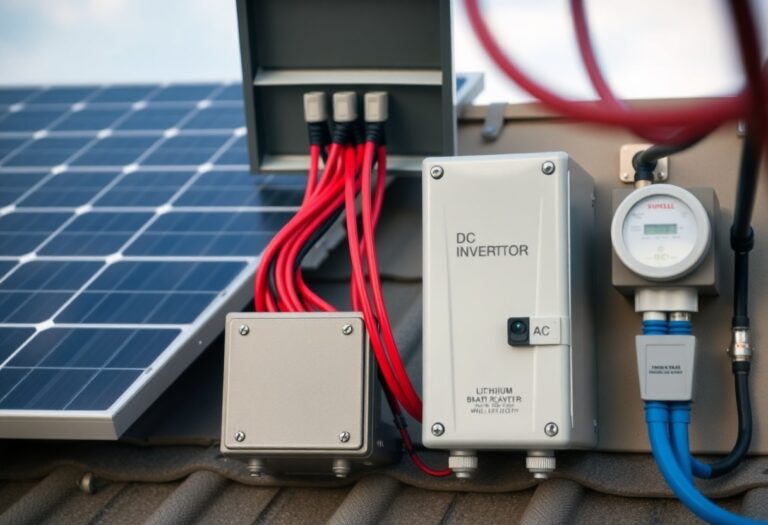

Overall, you should understand that solar panels produce DC power which an inverter converts to AC for your appliances and the grid; the inverter is the most important component for system compatibility. Be aware that DC can sustain dangerous arcs and is harder to isolate, while proper inverters and safety gear let you access clean, reliable solar electricity safely.
Key Takeaways:
- Solar panels produce DC; an inverter converts DC to AC for household use and grid export, and inverter type affects efficiency and system performance.
- Batteries and some chargers use DC, so DC-coupled systems cut conversion steps and improve round-trip efficiency and backup response compared with AC-coupled setups.
- DC systems require specific safety components and have higher arc considerations, while AC-centric designs are simpler for retrofits; choose based on storage needs, backup goals, and cost trade-offs.
Understanding AC Power
Definition and Characteristics
Alternating current (AC) reverses direction typically at 50 or 60 Hz, so your home outlets deliver either 230 V at 50 Hz in Europe or 120 V at 60 Hz in the U.S.; the sine-wave waveform lets transformers step voltage up or down, enabling long-distance transmission with lower I2R losses, and many appliances-motors, compressors, HVAC-are built to run directly on AC.
Advantages and Disadvantages
AC’s advantage is that you can easily transform voltage: stepping to 110-765 kV for grid transmission and back to household levels minimizes line losses, and most home devices accept AC directly; downside is that solar panels produce DC, so your system needs an inverter that adds ~2-5% conversion losses and introduces harmonics; additionally, high-voltage AC can be lethal and requires proper breakers and grounding.
For example, a typical 5 kW rooftop system uses a central inverter with ~95-98% efficiency, so 100-250 W can be lost as heat; you should weigh string versus microinverters-microinverters give panel-level MPPT and reduce shading losses but raise cost per watt by ~15-30%; grid-tie inverters must meet anti-islanding and synchronization standards, otherwise you risk backfeed during outages, and reactive power requirements can affect utility bills in some regions.
Understanding DC Power
Definition and Characteristics
Direct current (DC) flows in one direction and is what your solar panels and batteries naturally produce and store. You typically work with system voltages like 12 V, 24 V, and 48 V, and components such as MPPT charge controllers can boost energy harvest by 10-30% versus basic PWM under mismatch or partial shading. Because DC has no alternating frequency, it’s ideal for electronics, but low-voltage, long runs increase I²R losses and require thicker conductors.
Advantages and Disadvantages
DC offers clear advantages: direct battery charging, fewer conversion stages, and higher round-trip efficiency in DC-coupled systems. You must balance this with drawbacks: long DC runs at low voltage create significant resistive losses, and DC arc faults are harder to extinguish and more dangerous. Converting to AC also costs you energy-typical inverters are 90-98% efficient, so every conversion reduces usable output.
For example, a 5 kW PV array charging a battery at 48 V results in roughly 104 A; the same array into a 12 V bank requires over 400 A, demanding very large cables and creating substantial shock and fire risk. You can mitigate this by choosing higher-voltage banks, placing inverters close to sources, and installing DC-rated breakers and arc-fault protection per NEC guidelines.
Comparing AC and DC in Solar Systems
DC vs AC: Quick Comparison
| DC | AC |
|---|---|
| Source Panels/batteries output DC (30-50V per panel; strings often 600-1500V DC). |
Distribution Homes and grid use AC (120/240V residential). Inverters convert DC→AC for export and loads. |
| Losses Fewer conversions reduce loss; MPPT can boost yield 5-15% under partial shade. |
Conversion Each inverter adds ~2-5% loss; microinverters reduce panel-level loss but cost more. |
| Safety High-voltage DC creates steady arcs that are harder to interrupt – requires special safety measures. |
Compatibility AC wiring is standardized and safer for household circuits; easier integration with grid and appliances. |
| Best use Battery coupling and short-run panel arrays benefit from DC-first designs. |
Best use Whole-home systems and export to grid typically favor AC after a single inverter stage. |
Efficiency and Performance
You’ll see that keeping power in DC for as long as practical reduces conversion steps; a modern string inverter runs at 95-98% efficiency, while microinverters often hit 97-99% per panel. MPPT charge controllers can recover an extra 5-15% under mismatch or shading, and DC-coupled battery systems cut one conversion stage, improving round-trip efficiency (typical lithium batteries: 85-95%).
Cost Considerations
You’ll weigh upfront hardware and long-term replacement: a residential string inverter often costs about $1,000-$3,000, while microinverters run roughly $150-$300 per panel; batteries add thousands more. Design choices that reduce conversions can boost yield but may increase installation complexity and permitting fees, especially for high-voltage DC systems that demand extra protection.
Further, you should factor lifecycle costs: inverters usually need replacement every 10-15 years while panels last ~25 years; microinverters and optimizers carry longer warranties (often 20-25 years) but raise initial cost. In practice, opting for microinverters or module-level power electronics can improve production 2-10% in shaded or complex roofs, which can shorten your payback by years despite a higher upfront spend.
Inverters: The Heart of the System
Inverters sit between your panels and the grid, converting panel DC into grid-compatible AC while managing voltage, frequency, and safety protocols. Most modern residential units reach 96-99% efficiency and commonly range from 3-10 kW. They provide MPPT tracking, monitoring, and protections like anti-islanding and arc-fault detection so your array can export safely and support backup loads.
Types of Inverters
You’ll choose between centralized and distributed architectures based on shading, budget, and battery plans: string inverters excel in cost per watt, microinverters optimize per-panel output, power optimizers mitigate partial shading, and hybrid inverters combine PV and storage management.
- String inverters – centralized, 3-15 kW typical for homes.
- Microinverters – per-panel, higher yield under shading.
- Power optimizers – panel-level MPPT with a central inverter.
- Hybrid inverters – integrate batteries and grid-tie functions.
Thou, you should match inverter choice to your array layout, shading profile, and whether you plan on battery backup.
| Type | Quick fact |
|---|---|
| String inverter | Cost-effective, 3-15 kW, single MPPT for whole array. |
| Microinverter | Per-panel conversion, boosts yield under partial shading. |
| Power optimizer + inverter | Panel-level MPPT with central inverter; common with SolarEdge-style setups. |
| Hybrid inverter | Manages PV and batteries, supports backup and battery charging. |
Role in AC and DC Conversion
Inverters translate panel or battery DC into grid-synced AC at the correct frequency (50/60 Hz) and voltage, enforcing phase and waveform purity so your appliances run safely; grid-tied units must meet anti-islanding rules and often keep THD below 3% for sensitive electronics.
Delving deeper, inverters implement MPPT algorithms (often multiple trackers) to maximize energy harvest across varying irradiance and temperature; for example, microinverters can raise annual energy yield by ~5-15% in shaded roofs. You should note clipping: when array DC exceeds inverter input, excess potential is lost. Hybrid models handle charge/discharge logic for 48 V battery banks and affect overall system round-trip efficiency, while advanced grid-tied inverters can provide reactive power support, frequency response, and remote firmware updates to comply with evolving grid codes.
Installation and Maintenance Considerations
Plan conduit runs and inverter placement to minimize DC run lengths-keeping voltage drop under 3% reduces losses; panels typically output 30-50 V, but string voltages can reach 600-1,000 V, so you must size conductors and conduit accordingly. Install combiner boxes and accessible disconnects, locate batteries in ventilated, temperature-controlled spaces, and schedule inspections yearly with panel cleaning 1-2 times per year and torque checks annually. Microinverters lower maintenance and isolate failures; string inverters often deliver 96-98% efficiency but centralize single-point failure risk.
Best Practices for AC and DC Systems
Separate DC and AC runs and clearly label all conductors; put the DC combiner and rapid-shutdown equipment adjacent to the array while placing the AC inverter and meter-side disconnect within 10-15 ft of the service to minimize conversion losses. Use appropriately sized fuses and DC-rated breakers, maintain ground-fault and arc-fault protection per local code, and prefer microinverters or MLPE for module-level monitoring to speed troubleshooting and limit system downtime.
Safety Measures
Always follow lockout/tagout and wear insulated gloves and eye protection rated for the system voltage; DC arcs are more persistent than AC because they lack zero crossings, so use arc-fault detection and rapid-shutdown devices. Keep batteries isolated with ventilation and a dedicated fire extinguisher, post clear labels at both array and service entrances, and have any work above 50 V DC performed by a qualified electrician.
Test equipment must be rated above the array’s open-circuit voltage-individual panels are ~30-50 V, but strings can hit 600-1,000 V; use meters and PPE with matching voltage ratings. Perform thermal imaging annually to find hot joints, verify torque values with calibrated tools, and confirm rapid-shutdown and arc-fault modules function during commissioning and every year thereafter. If you encounter energized conductors, stop work and contact your installer or emergency services.
Future Trends in Solar Power
Expect your home system to evolve toward higher-voltage and DC-focused designs: 1500V strings and DC-coupled storage reduce wiring and conversion steps, while bifacial modules can boost yield by 5-15% depending on roof reflectivity. You’ll see wide adoption of SiC/GaN power electronics that often exceed 98% inverter efficiency, but higher DC voltages also raise arc and fire risk, so rapid shutdown and AFCI protection become nonnegotiable.
Innovations in AC and DC Technologies
Manufacturers are shipping hybrid topologies: per‑panel microinverters and optimizers cut mismatch or shading losses by up to ~20%, while DC-coupled battery inverters eliminate an extra DC→AC→DC cycle, improving round‑trip system efficiency by 2-5 percentage points. You’ll encounter more compact, high-frequency SiC/GaN converters, and research into solid‑state transformers and household DC microgrids is pushing lower losses and faster controls.
Market Outlook
Module prices have dropped roughly ~90% since 2010, driving annual global additions to exceed 200 GW in recent years; that means more competitive rooftop economics and faster uptake of solar+storage. You’ll find financing (loans, leases, PACE) and incentive shifts moving homeowners toward integrated systems sized for self‑consumption and resilience, not just export to the grid.
Geographic demand will vary: China and India continue to dominate utility builds, while the US, EU and Australia lead residential uptake. You should plan for declining feed‑in incentives and growing emphasis on grid services – expect more time-of-use rates, V2G participation, and 10-20 kWh residential batteries as standard options, but also increased interconnection scrutiny and curtailment in high‑solar regions.
FAQ
Q: What are the main differences between AC and DC power in home solar systems?
A: Solar panels generate direct current (DC). Most household appliances and the utility grid use alternating current (AC), so an inverter is used to convert DC to AC for household use and grid export. Batteries store DC, and a charge controller or battery inverter/charger manages panel-to-battery charging (often with MPPT to maximize power). Every conversion (DC→AC or AC→DC) incurs efficiency losses and adds components and cost. System architecture determines where and how often conversions happen: a DC-coupled system keeps solar output in DC for battery charging before converting to AC, while an AC-coupled system converts panel DC to AC immediately and uses an AC-coupled battery inverter if batteries are present.
Q: Can I run appliances directly on DC to increase efficiency?
A: Some appliances (LED lighting, DC motors, certain electronics) can run on DC and avoid inverter losses; low-voltage DC circuits (12/24/48 V) are common in off-grid setups and small DC loads. Benefits include fewer conversions and higher end-to-end efficiency for those loads. Downsides are limited availability of household appliances designed for DC, stricter voltage-drop limits that require larger conductors over distance, and code/safety constraints in many jurisdictions. For whole-house use, AC remains more practical because almost all mainstream appliances and safety devices are designed for AC and grid integration.
Q: Should my home solar system be designed as AC-coupled or DC-coupled, and what factors determine the best choice?
A: Choice depends on goals and context. AC-coupled systems (solar → inverter → AC → battery inverter) are common for grid-tied installations and are ideal for retrofits because they integrate easily with existing inverters and the grid. DC-coupled systems (solar → charge controller → battery → inverter) can be more efficient for systems where batteries are central, since solar energy can be stored without an extra DC→AC→DC conversion. Considerations: whether you want battery backup, expected efficiency and round-trip losses, initial cost, future expandability, site voltage limits, and local electrical code. For new installs focused on maximizing battery storage efficiency, DC-coupled or hybrid inverter architectures often make sense; for adding batteries to an existing grid-tied system, AC-coupled is usually simpler and less expensive. Consult a qualified installer and check local regulations before deciding.