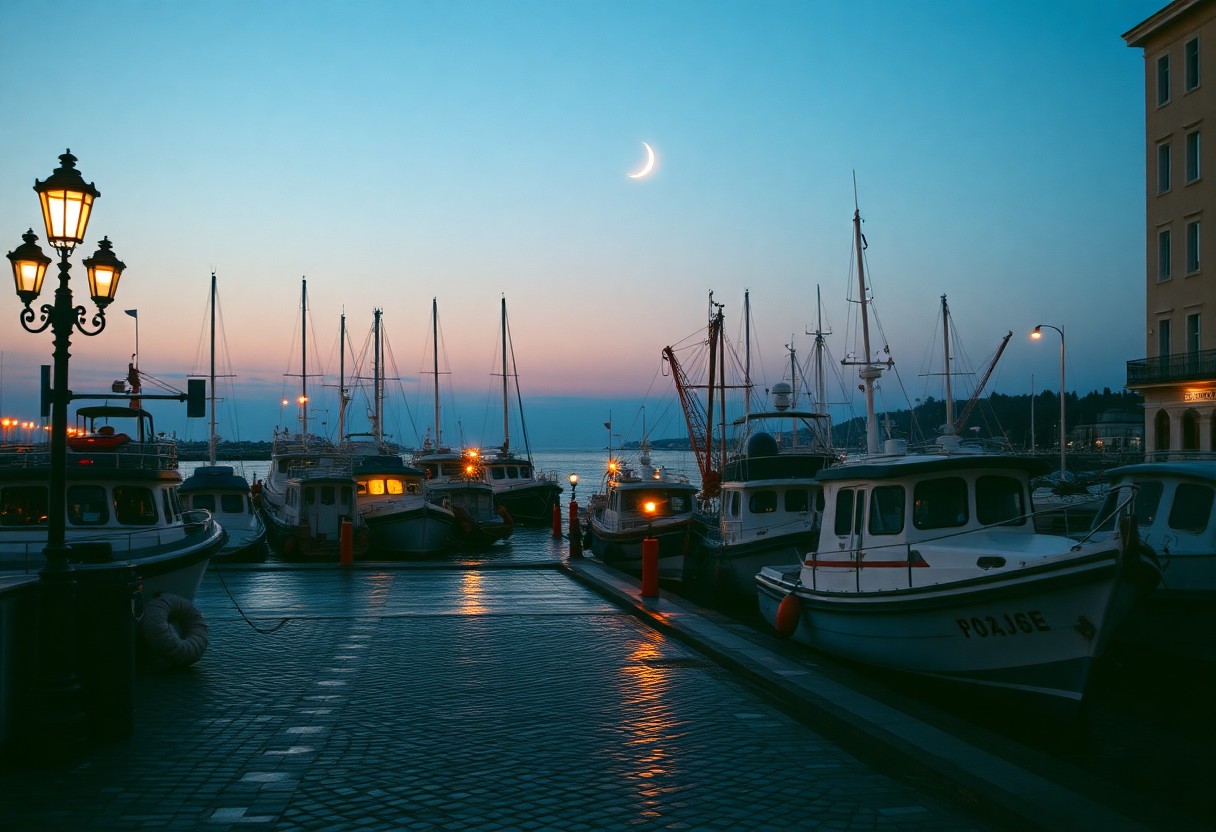
Most nights, when the sun dips below the horizon you witness rapid shifts: light fades and reduced visibility alters navigation and raises accident and crime risk, temperatures fall, nocturnal wildlife and insects become active, and your circadian system nudges you toward sleep-offering restorative darkness and a clearer view of stars; understanding these effects helps you plan safety, sleep, and activities after dusk.
Key Takeaways:
- Nighttime brings radiative cooling that lowers temperatures and often produces dew, fog, or temperature inversions.
- Biological activity shifts: nocturnal species become active while diurnal animals and humans enter sleep-driven circadian phases with increased melatonin.
- Light conditions change: photosynthesis ceases, stars and planets appear, and artificial lighting alters visibility and ecosystem behavior.
The Science of Sunset
As solar rays intersect the horizon, geometry and atmospheric physics dictate how light fades and colors change; atmospheric refraction lifts the sun by about 34 arcminutes (≈0.57°), extending visible daylight by minutes. Twilight is divided into civil (0° to −6°), nautical (−6° to −12°) and astronomical (−12° to −18°) phases, and at higher latitudes these stages can stretch into hours, altering how quickly you transition from usable light to true night sky.
The Mechanics of Dusk
You’re witnessing a combination of Earth’s curvature, refraction, and scattering: as the sun’s rays travel through an increasingly long air column they redden and dim. At the equator twilight often lasts ~20-30 minutes, whereas at 60°N it can take several hours; because light drops rapidly, reduced visibility and glare increase driving and maritime hazards, so you should adapt speed, lighting, and navigation accordingly.
The Role of Atmosphere
How you perceive sunset colors hinges on scattering and particles: Rayleigh scattering preferentially removes blue wavelengths, leaving reds when the sun is low, while aerosols, dust, smoke or volcanic ash enhance reds and oranges-after Mount Pinatubo (1991) and Krakatoa (1883) people worldwide reported vivid displays. For photographers the golden hour’s warm tones are highly sought, yet intense red skies can also indicate elevated air pollution affecting health.
Quantitatively, Rayleigh scattering scales as ~1/λ^4, so blue (~450 nm) is scattered roughly 4× more than red (~650 nm), shifting the late-day spectrum you observe. Atmospheric refraction disperses colors-under a clear ocean horizon you might even catch the fleeting green flash when short wavelengths briefly peek above the rim. Temperature inversions and high aerosol optical depth (e.g., τ>0.2 after major eruptions) prolong color-rich twilight and influence your local air quality.
Effects on the Environment
Changes in Temperature
When evening sets in, radiative cooling drives surface temperatures down quickly; you can expect drops of 5-15°C within hours in many continental zones, while deserts may exceed 20°C declines. Nighttime inversions commonly trap pollutants near the ground, raising local health risks, and dew or frost forms as surfaces hit the dew point, affecting crops and transportation. Urban areas retain heat in concrete and asphalt, so your nights there stay several degrees warmer than nearby rural landscapes.
Temperature effects at night
| Factor | Typical effect |
|---|---|
| Radiative cooling | Surface temperature fall (5-15°C typical) |
| Temperature inversion | Pollutant trapping near ground; poorer air quality |
| Dew/frost formation | Increased humidity; crop and road hazard |
| Urban heat island | Reduced nighttime cooling (often 2-6°C) |
Nocturnal Wildlife Adaptations
You’ll notice animals use anatomy and behavior to exploit darkness: echolocation in bats (generally 20-200 kHz) lets them hunt swarms of insects-many species consume up to 50% of their body weight nightly-while owls combine facial discs and asymmetric ears to localize prey to within a few degrees. Artificial light disrupts these interactions, drawing insects and disorienting predators and prey alike.
You observe structural adaptations like the tapetum lucidum in many nocturnal mammals that reflects photons to boost sensitivity, and owls’ ear asymmetry plus dense rod-packed retinas optimized for low light. Moths detect bat ultrasound (roughly 20-100 kHz) and perform evasive maneuvers; bats counter by shifting call frequency or hunting strategy. When you introduce persistent lighting, these fine-tuned predator-prey dynamics can break down, reducing natural pest control and altering local food webs.
Cultural Significance
Sunset in Art and Literature
Artists and writers have long used sunset to signal endings and transformation: J.M.W. Turner’s 1839 The Fighting Temeraire bathes a retiring warship in a fiery orange, Impressionists in the 1870s made dozens of studies of shifting light, and authors from Ernest Hemingway (The Sun Also Rises, 1926) to Pablo Neruda fold dusk into metaphors of loss and renewal; when you study these works, fading color and tempo map emotional closure.
Rituals and Traditions
Sunset governs daily and weekly rites: you mark Shabbat at sunset with candle lighting (many Ashkenazi communities light 18 minutes before sundown), Muslims observe the Maghrib prayer immediately after the sun dips below the horizon, and Hindu aartis-like Varanasi’s Ganga Aarti-use lamps and music at dusk to convert sunset into communal reflection and blessing.
Across traditions you’ll see precise timing and practical adaptations: Islamic prayer windows rely on twilight phases, Jewish observance uses sunset-to-nightfall calculations, and in high latitudes-where the sun can set after 11:00 PM in summer or not at all in polar day-communities often adopt fixed-clock times. You should note that public rituals with open flames and dense crowds pose fire and safety hazards, so authorities commonly require permits, barriers and designated safe zones to protect participants.
Psychological Impact
As dusk falls, your brain shifts from alertness to restoration: melatonin secretion rises, cortisol falls, and neural networks begin prioritizing consolidation over stimulation. That biological pivot explains why you may feel calmer yet more reflective; in contrast, abrupt light loss can trigger agitation or low mood in susceptible people. Light therapy using 10,000 lux boxes in the morning remains an evidence-based countermeasure for pronounced seasonal mood shifts.
Mood Changes with Diminishing Light
You often notice increased sleepiness, lowered motivation, or irritability as light wanes, driven by circadian phase shifts and neurotransmitter changes-serotonin turnover can dip. Epidemiological data show seasonal affective symptoms vary by latitude, affecting roughly 1-10% of populations in colder, darker regions. If your mood deepens toward depression or you lose interest in daily tasks, that pattern signals a need to adjust light exposure and routine.
Benefits of Evening Calm
When you cultivate evening calm, your autonomic state shifts: cortisol falls, heart rate variability improves, and sleep onset becomes faster-often by tens of minutes when screens and bright lights are reduced. Implementing a 20-30 minute wind-down (breathing, reading, low-light activities) enhances sleep quality and daytime cognition, helping you wake more refreshed and mentally flexible.
Practically, you can dim overhead lights to under 100 lux and stop blue-light devices 60-90 minutes before bed to maximize melatonin production; these steps routinely cut sleep latency and nighttime awakenings. Many people report measurable gains-better memory consolidation after 7-9 hours of sleep and reduced evening rumination-when they pair dimming with a brief relaxation practice. Emphasizing routine consistency yields the biggest benefit over weeks, not days.
Urban vs. Rural Sunset Experiences
Cityscapes at Dusk
Streets and glass facades turn sunset into a backlit show, but if you live in a city you’ll also face heavy light pollution: over 80% of people worldwide cannot see the Milky Way, and urban heat islands keep nights 1-7°C warmer than nearby countryside. Artificial light attracts insects and contributes to up to one billion bird collisions annually in North America by some estimates. Still, your city benefits from extended nightlife, 24‑hour services, and more evening transit options that reshape after-dark routines.
Natural Settings and Twilight
Away from streetlights, your horizon opens to the Milky Way and perhaps 2,000-6,000 visible stars on a clear night; over 200 International Dark Sky places worldwide protect those views. You’ll notice temperatures fall faster as surfaces radiate heat, while bats, owls and moths become active and soundscapes shift-creating better conditions for stargazing and a markedly different nocturnal ecology than in urban areas.
Twilight is precisely defined: civil (sun 0° to −6°), nautical (−6° to −12°) and astronomical (−12° to −18°); when the sun sinks past −18° you reach full darkness for serious astronomy. Depending on latitude and season twilight can last minutes at the equator or several hours near the poles, so you might gain more observing time in high latitudes, see tens to hundreds of meteors per hour during major showers, and experience dew or frost from rapid radiative cooling within an hour of sunset.
Observing the Sunset
When you track a sunset, focus on changing color gradients and atmospheric layers: aerosols and water vapor shift blue scattering to vivid reds and oranges, often within a 10-20 minute window of peak color. Bring binoculars to spot crepuscular rays and note that coastal humidity or urban smog can intensify reds while also reducing visibility-so plan routes accordingly. Scientists measure chromatic shifts in nanometers; you can observe them simply by timing from 15 minutes before to 30 minutes after the horizon dip.
Best Locations and Times
Choose west-facing coasts, hilltops above 200 meters, or open deserts for unobstructed horizons; city rooftops work if you want silhouetted skylines. Aim to arrive 30-45 minutes before sunset and stay at least 20 minutes after for post-sunset color and the blue hour. Use apps like The Photographer’s Ephemeris or Sun Surveyor to find exact azimuth and elevation; avoid cliff edges and slippery rocks because fading light increases hazard risk.
Tools for Sunset Photography
Pack a sturdy tripod, a wide-angle 16-35mm and a 70-200mm tele for sun compression, graduated ND filters, polarizer, and a remote shutter or intervalometer. Shoot RAW and bracket exposures by ±2 EV to capture high dynamic range, and use mirror lockup or electronic first curtain to reduce shake. Protect your eyes when framing the sun-use live view or ND filters rather than direct viewing to avoid eye damage.
For settings, start at ISO 100, aperture f/8-f/11, and adjust shutter for proper exposure; with ND filters you can extend to multi-second exposures for smooth water. Rely on the histogram and expose-to-the-right to retain highlights, then blend brackets in software or use exposure fusion. Smartphones with manual apps (e.g., ProCam) plus clip-on ND filters work-just keep composition simple and level to avoid horizon drift during long exposures.
Summing up
On the whole you would face rapid darkness, plummeting temperatures, and collapsing ecosystems; within days to weeks society and infrastructure would struggle as photosynthesis stops and food chains fail. Your best immediate actions are to secure heat, power, and shelter while long-term survival depends on stored food, alternative energy, and community coordination. For technical timelines and scenarios see How long would we last if the sun went out, just hours or …
FAQ
Q: Why does the sky change color when the sun goes down?
A: As sunlight passes through more atmosphere at sunset, shorter blue and violet wavelengths scatter out of the direct beam more strongly than longer red and orange wavelengths (Rayleigh scattering). The longer path through air and particles removes bluer light, so the direct sunlight that reaches your eyes is richer in red and gold. Aerosols, dust, and pollution can amplify or mute these colors, and clouds can reflect and refract the remaining light to create vivid displays. Twilight also includes successive phases-civil, nautical, and astronomical-each defined by how far the sun is below the horizon and how much scattered light remains in the sky.
Q: How do plants and animals respond when the sun sets?
A: Many organisms shift behavior at dusk because their internal clocks (circadian rhythms) and environmental cues change with light levels. Diurnal animals wrap up feeding and seek shelter, nocturnal species like bats, owls, and many insects become active, and crepuscular animals (e.g., deer, some mosquitoes) peak around dawn and dusk. Plants may close stomata, fold leaves, or open night-blooming flowers that attract nighttime pollinators. Sudden or artificial lighting can disrupt these patterns, altering feeding, mating, and migration behaviors and affecting entire ecosystems.
Q: What physical changes occur on Earth after sunset, and how do they affect people?
A: After sunset the ground and air lose incoming solar heating and begin radiative cooling, which often leads to falling temperatures, formation of dew or fog, and a more stable nocturnal boundary layer near the surface. Atmospheric conditions at night can trap pollutants near the ground or, under clear calm conditions, allow them to disperse differently than during daytime. The dark sky reveals stars, planets, and the Milky Way where light pollution is low; conversely, artificial lighting creates skyglow that hides celestial objects and can disrupt sleep by suppressing melatonin in humans. Nighttime also shifts human activities-commuting, commerce, and energy use change-which influences safety, health, and urban planning decisions.